NCLEX-RN Hyperkalemia Response Clock Cheat Sheet (Free Printable)
Free NCLEX-RN hyperkalemia response clock cheat sheet — printable study guide for nursing students. Every fact verified against authoritative sources.
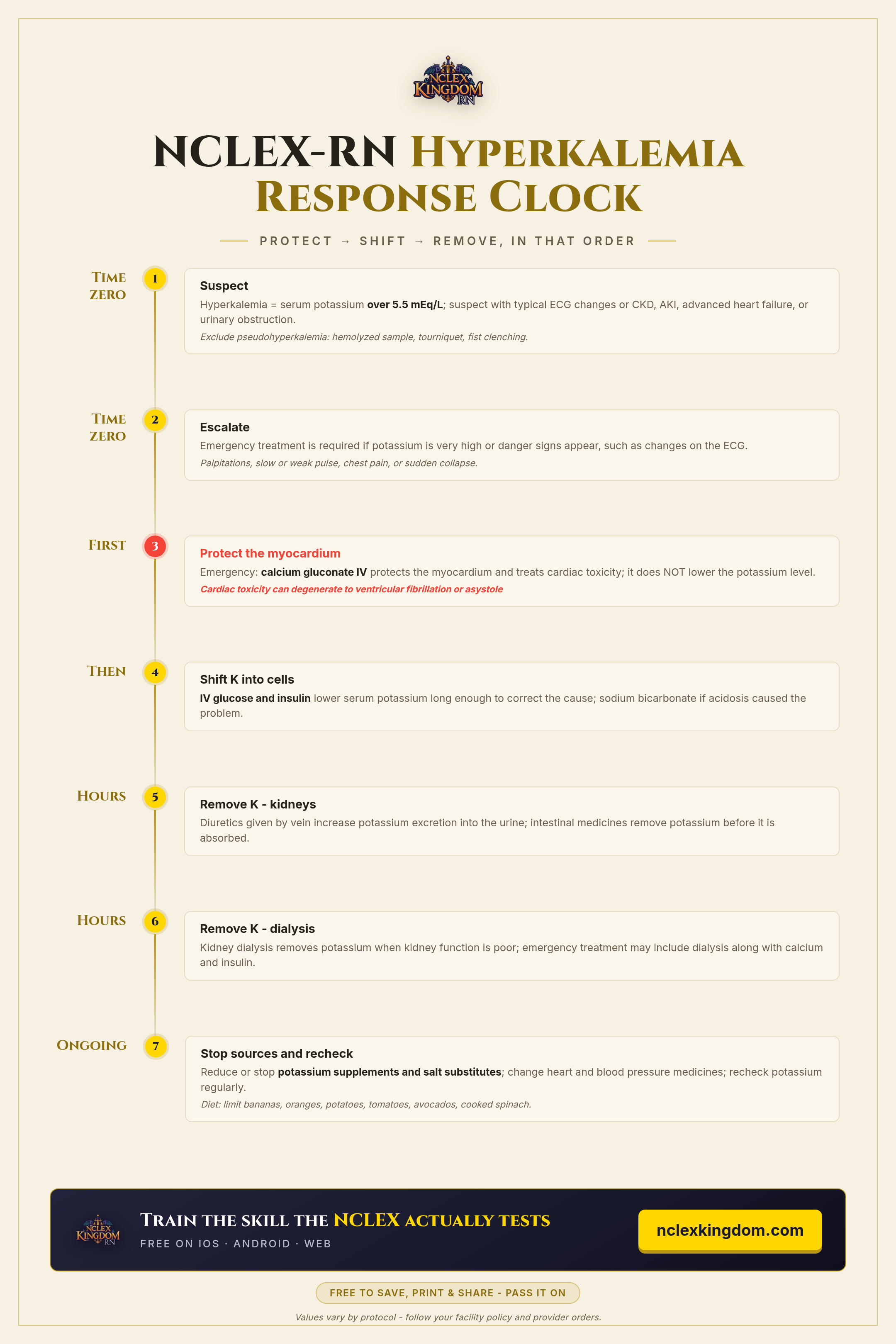
The NCLEX-RN keeps returning to hyperkalemia because its questions rarely stop at the definition - they ask what you do first. The Hyperkalemia Response Clock cheat sheet answers that with a timeline. It opens at time zero: hyperkalemia means a serum potassium over 5.5 mEq/L, suspected with typical ECG changes or CKD, AKI, advanced heart failure, or urinary obstruction, after excluding pseudohyperkalemia - a hemolyzed sample, a tourniquet, or fist clenching. From there it walks through escalation for danger signs, calcium gluconate to protect the myocardium, IV glucose and insulin to shift potassium into the cells, removal by diuretics, intestinal medicines, or dialysis, and finally stopping potassium supplements and salt substitutes, changing heart and blood pressure medicines, rechecking levels, and limiting foods like bananas, potatoes, and avocados.
The exam tests this because the sequence is the treatment: protect, then shift, then remove - and because calcium protects the heart without lowering the potassium, a distinction that trips people up. Trace the order until it is automatic, and keep the sheet's own caveat in mind: values vary by protocol, so follow your facility policy and provider orders.
184 words. Every claim traces to the JSON (threshold, risk factors, pseudohyperkalemia causes, stage order, calcium's non-lowering role, diet list, disclaimer); sources cited in the JSON are Merck Manual and MedlinePlus.
Tap to open the full-size image in a new tab.
Values vary by protocol - follow your facility policy and provider orders.
Want to practice applying this under exam pressure? NCLEX Kingdom has thousands of NCLEX-style questions - start free in your browser.