Clinical
NCLEX-RN Congenital Heart Defects Cheat Sheet (Free Printable)
Free NCLEX-RN congenital heart defects cheat sheet — printable study guide for nursing students. Every fact verified against authoritative sources.
Congenital heart defects are a staple of NCLEX-RN prep because the questions ask you to sort, not recite. Is this shunt left-to-right or right-to-left? Is pulmonary flow increased or decreased? This cheat sheet does that sorting for you across six tables: left-to-right shunts (VSD, ASD, PDA - increased pulmonary flow, no cyanosis), right-to-left shunts (tricuspid atresia - decreased flow, cyanosis), obstructive defects (coarctation, aortic stenosis), the mixed lesion TGA, the hypercyanotic tet spell, and the ductus drug rule. The exam tests this content because each scenario compresses recognition, prioritization, and emergency response into one case, and the sheet mirrors that: knee-chest position and oxygen come before morphine and IV fluids in a tet spell, indomethacin closes a PDA while PGE1 opens it, and critical coarctation can present as shock when the ductus closes in the first 7 to 10 days. Use it actively: read each kicker first, name the category, then quiz yourself on the first action. TOF is the most common cyanotic defect at 4.7 per 10,000, and one third of PDAs close on their own - facts like these anchor memory. Sort the shunt, fix the flow.
185 words. Every claim traces to the JSON: section kickers for the flow/cyanosis framing, row text for the tet spell sequence and drug rule, note fields for the 7-to-10-day shock window, 4.7 per 10,000, and one-third spontaneous closure, subtitle for the closing line.
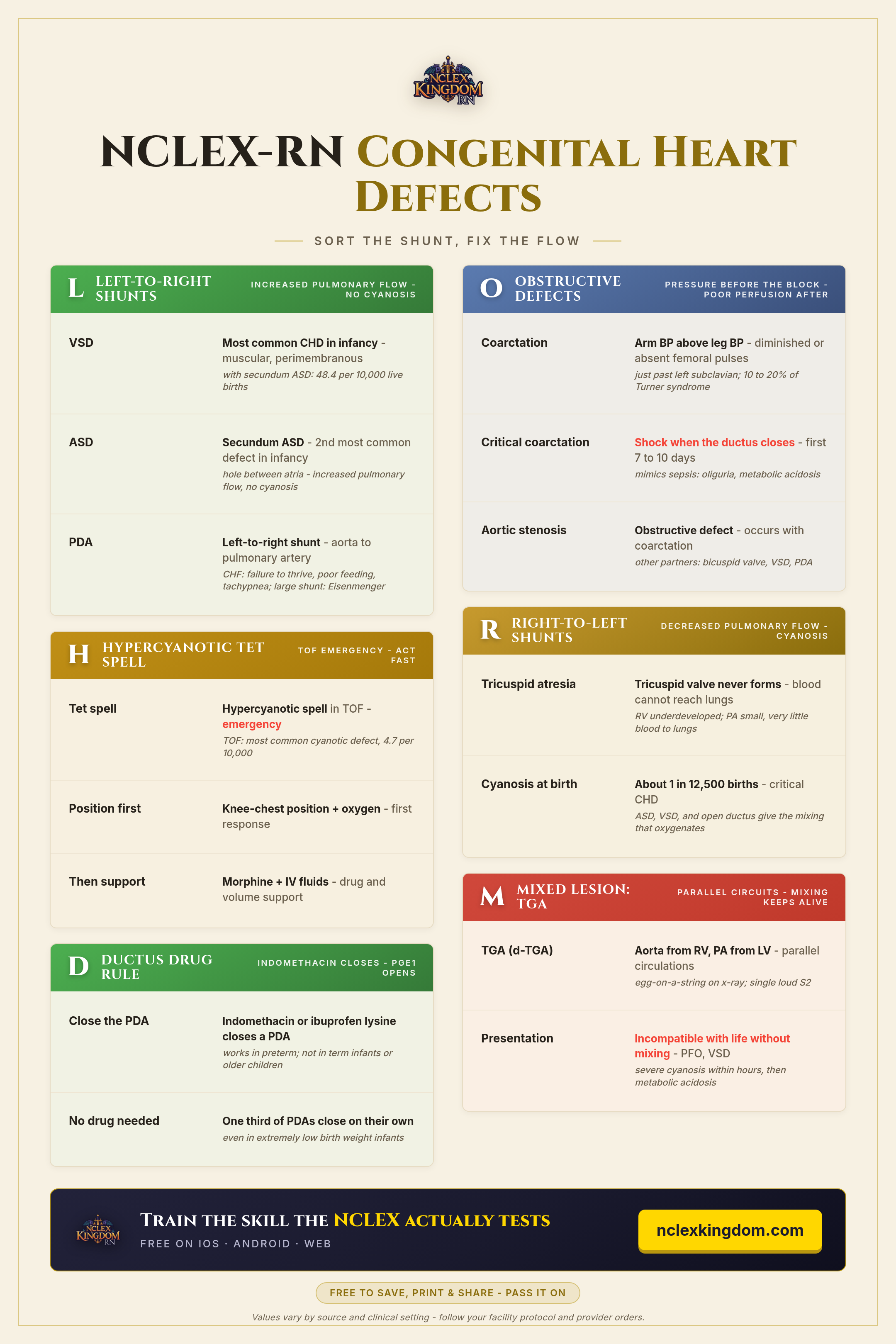
Tap to open the full-size image in a new tab.
Values vary by source and clinical setting - follow your facility protocol and provider orders.
Want to practice applying this under exam pressure? NCLEX Kingdom has thousands of NCLEX-style questions - start free in your browser.