NCLEX-RN Chest Tube Management Cheat Sheet (Free Printable)
Free NCLEX-RN chest tube management cheat sheet — printable study guide for nursing students. Every fact verified against authoritative sources.
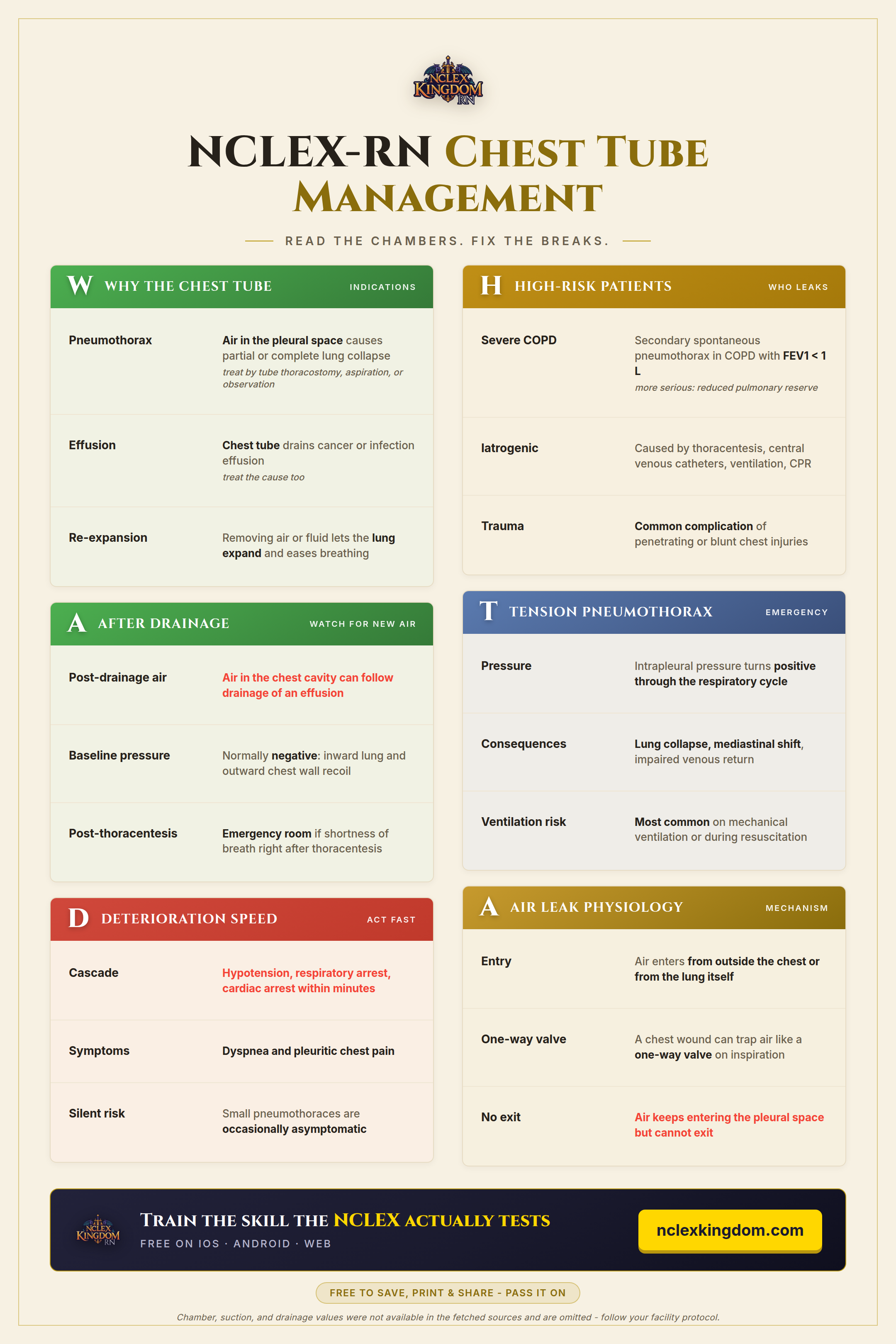
Chest tube questions on your NCLEX-RN hinge on two things: why the tube is in and what breaks. This cheat sheet covers both. First, the indications: pneumothorax, air in the pleural space causing partial or complete lung collapse, and cancer or infection effusions, which a tube drains, re-expanding the lung and easing breathing. The physiology: air enters from outside the chest or from the lung itself, a chest wound can trap air like a one-way valve on inspiration, and air keeps entering but cannot exit. That sets up tension pneumothorax, most common on mechanical ventilation or during resuscitation: intrapleural pressure turns positive, with lung collapse, mediastinal shift, impaired venous return, and then hypotension, respiratory arrest, and cardiac arrest.
The exam drills this because deterioration happens within minutes. The sheet also flags who leaks: severe COPD with FEV1 below 1 L, chest trauma, and iatrogenic leaks from thoracentesis, central venous catheters, ventilation, or CPR. Study the cards: the dyspnea and pleuritic chest pain, small pneumothoraces that are occasionally asymptomatic, and the new air that can follow effusion drainage. Chamber, suction, and drainage values are not covered - follow your facility protocol.
189 words; every clinical statement traces to a JSON row, and the closing sentence carries the sheet's own disclaimer.
Tap to open the full-size image in a new tab.
Chamber, suction, and drainage values were not available in the fetched sources and are omitted - follow your facility protocol.
Want to practice applying this under exam pressure? NCLEX Kingdom has thousands of NCLEX-style questions - start free in your browser.