
Why Traditional NCLEX Prep Feels Like Punishment (And What We're Building Instead)
If you've ever sat down to study for the NCLEX and felt your soul slowly draining away, you're not experiencing a personal failing—you're experiencing a design problem. Traditional NCLEX preparation materials weren't built with human motivation in mind. They were built around content delivery, question banks, and the assumption that fear of failure would be sufficient fuel to carry nursing students through months of grinding study sessions. This approach might check the box of "comprehensive test prep," but it fundamentally misunderstands how people actually learn and, more importantly, how they sustain the daily effort required to master complex material over an extended period.
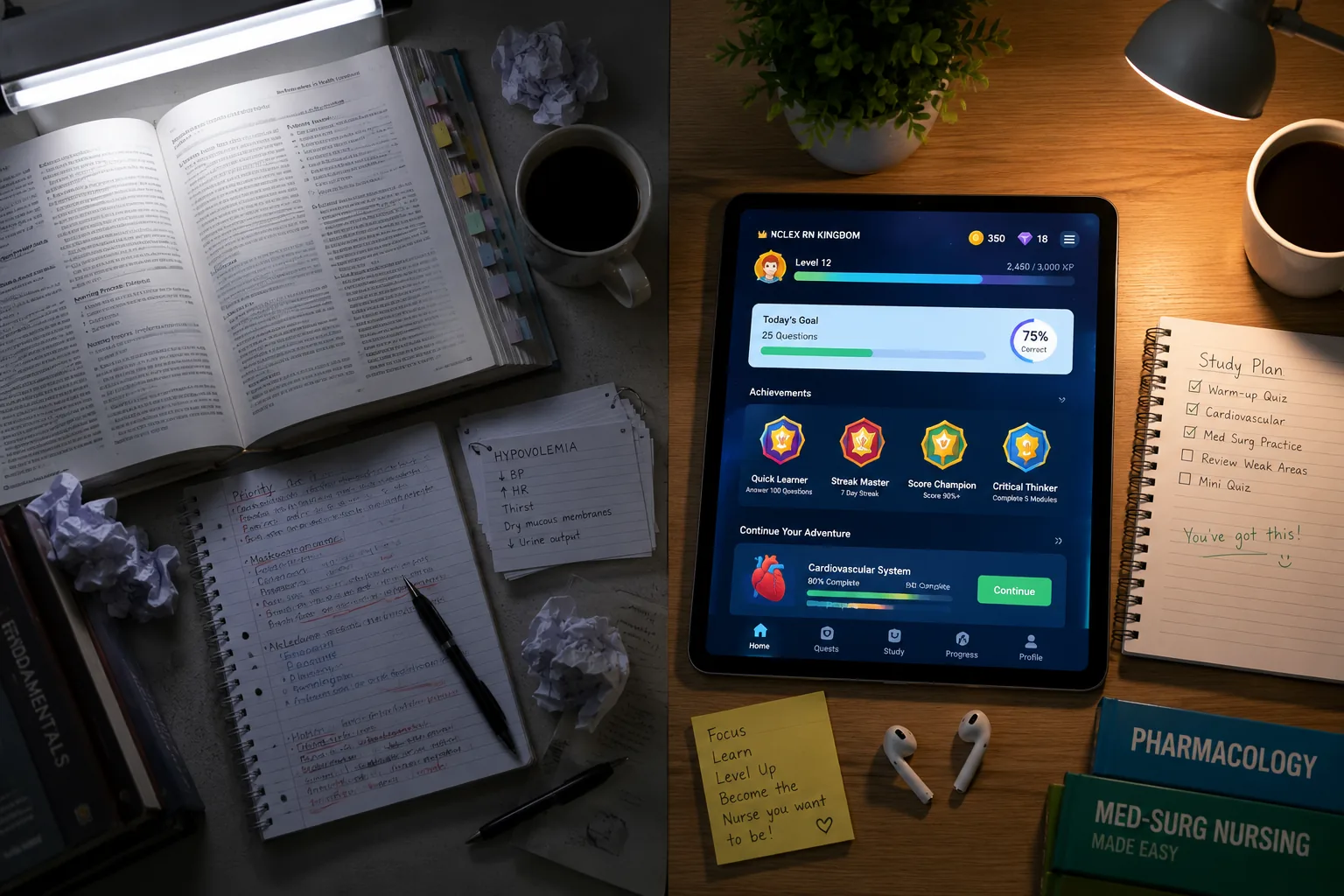
The result is a preparation experience that feels punitive rather than empowering. Students open their study materials with a sense of dread rather than curiosity. They force themselves through practice questions, motivated primarily by anxiety rather than genuine engagement with the material. This isn't just unpleasant—it's pedagogically ineffective, because sustained learning requires sustained attention, and sustained attention requires something more than willpower alone.
The Fundamental Flaw in Conventional NCLEX Study Design
Traditional NCLEX preparation operates on what might be called a "textbook plus question bank" model. Students are presented with dense reference material to memorize, followed by endless practice questions designed to assess whether that information stuck. The underlying assumption is that nursing students, faced with the high stakes of the NCLEX exam, will simply buckle down and push through the monotony because passing the exam matters so much to their careers. While it's true that the NCLEX matters tremendously, this design philosophy conflates importance with engagement, assuming that something's significance automatically translates into motivation to study it daily.
The problem emerges clearly when you consider the actual experience of using these materials day after day. A nursing student sits down after a long clinical shift or a full day of classes, already mentally and physically exhausted. They open their study materials and are immediately confronted with the sheer volume of content they haven't yet mastered and the intimidating number of practice questions still ahead of them. There's no sense of progress, no celebration of what they've already accomplished, and no element of discovery or surprise. The experience provides nothing to look forward to beyond the distant, abstract goal of passing an exam that might be weeks or months away. For all but the most self-disciplined individuals, this setup is a recipe for procrastination, inconsistent study habits, and eventual burnout.
What makes this particularly frustrating is that we've known for decades how to design experiences that people return to willingly and enthusiastically. Game designers have spent years perfecting the art of creating engaging experiences that balance challenge with reward, provide clear feedback loops, and give users a sense of progression and achievement. These aren't manipulative tricks—they're applications of fundamental psychological principles about what motivates human behavior and sustains engagement over time. Yet the educational technology space, and NCLEX prep in particular, has been remarkably slow to incorporate these insights into study tools.
Why Making Studying Fun Isn't About Making It Easy
When we talk about gamifying NCLEX preparation, a common misconception emerges: that making something fun means making it easier, less rigorous, or somehow "dumbing down" the content. This misunderstanding stems from a false dichotomy between engagement and rigor, as if learning must be unpleasant to be legitimate. In reality, gamification done properly doesn't reduce the difficulty or comprehensiveness of the material—it changes the psychological experience of engaging with that material so that students are motivated to tackle harder challenges rather than avoiding them.
The distinction is crucial. A gamified study experience still requires nursing students to master pharmacology, understand complex pathophysiology, apply critical thinking to patient scenarios, and demonstrate comprehensive knowledge across all areas of nursing practice. The content standards don't change. What changes is the delivery mechanism and the feedback system. Instead of confronting an undifferentiated mass of questions, students encounter structured challenges that provide immediate feedback, recognize achievement, and create a sense of forward momentum. This approach leverages what psychologists call "intrinsic motivation"—the internal drive to engage with an activity because the activity itself is rewarding, not just because of external consequences like passing or failing an exam.
Research in educational psychology consistently demonstrates that intrinsic motivation leads to deeper learning and better retention than extrinsic motivation alone. When students study primarily out of fear or obligation, they tend to engage in surface-level learning—memorizing facts long enough to answer questions correctly without developing deep understanding. When students study because the experience itself is engaging, they're more likely to explore concepts more thoroughly, make connections between ideas, and retain information for the long term. This isn't speculation; it's established educational science. The challenge has always been how to create that intrinsically motivating experience within the context of serious professional exam preparation.
The Design Philosophy Behind NCLEX Kingdom
Building NCLEX Kingdom required rethinking NCLEX preparation from the ground up, starting not with "How do we deliver NCLEX content?" but rather "How do we create an experience that nursing students will actually want to return to every single day?" This shift in the fundamental question led to fundamentally different design decisions. Instead of organizing the app around content categories and question banks, we organized it around progression systems, achievement mechanics, and daily engagement loops that create natural study habits.
The gamification elements aren't superficial additions layered on top of traditional study materials—they're core to how the entire learning experience is structured. Students don't just answer practice questions; they advance through levels, unlock new challenges, and see tangible evidence of their growing mastery. This transforms the psychological experience from "I have to get through X more questions" to "I want to see what comes next." That subtle shift in framing makes an enormous difference in whether students show up to study consistently or find excuses to postpone their prep work.
Critically, this approach addresses the specific challenge of the NCLEX preparation timeline. Unlike studying for a quiz next week, NCLEX prep often spans months. Traditional study materials offer no meaningful way to track progress through that extended timeline beyond crude metrics like "percentage of question bank completed." Without granular milestones and frequent wins, students lose motivation during what psychologists call the "messy middle"—that long stretch between the initial enthusiasm of starting and the urgent sprint of the final weeks before the exam. Gamification fills that middle period with ongoing goals, regular achievements, and a constant sense that today's study session matters and moves you meaningfully forward.
Bridging Engagement and Educational Outcomes
The ultimate measure of any NCLEX preparation tool isn't how fun it is—it's whether students pass the exam. This is where the gamification approach demonstrates its real value, because the connection between enjoyment and outcomes isn't incidental; it's causal. Students who enjoy their study experience study more consistently. Students who study more consistently see more practice questions, reinforce concepts through repetition, and develop the pattern recognition skills essential for NCLEX success. Students who see tangible progress remain motivated through the full preparation period rather than cramming inconsistently or giving up midway through.
What we're building with NCLEX Kingdom is a tool that recognizes this chain of causation and optimizes for it intentionally. By making the daily study experience something nursing students look forward to rather than dread, we increase the likelihood that they'll maintain consistent study habits throughout their preparation period. By providing clear feedback and achievement recognition, we help students develop accurate self-assessment and identify areas where they need additional focus. By structuring content as progressive challenges rather than an overwhelming repository, we reduce the anxiety that causes procrastination and avoidance.
None of this diminishes the rigor of NCLEX preparation or pretends that passing the exam is easy. The NCLEX is a challenging, high-stakes examination that requires comprehensive nursing knowledge and sophisticated clinical reasoning skills. What gamification changes is not the difficulty of the content but the sustainability of the preparation process. It's the difference between a study approach that burns students out after two weeks and one that keeps them engaged and progressing for months. It's the difference between forced willpower and genuine momentum.
What This Means for the Future of Nursing Education
The broader implication of this approach extends beyond just NCLEX preparation to how we think about professional education in healthcare generally. For too long, difficult or important educational goals have been treated as if they require unpleasant learning experiences—as if suffering through boring materials is somehow proof of seriousness or dedication. This mindset does a disservice to learners and to the professions they're entering. Nursing students who approach their NCLEX preparation with enthusiasm and confidence, rather than dread and anxiety, aren't less serious about their careers—they're better positioned to succeed in them.
The evidence from adjacent fields supports this conclusion. Medical education has increasingly incorporated simulation, interactive learning, and engagement-focused pedagogy precisely because these approaches produce better clinical reasoning and knowledge retention than passive learning from textbooks and lectures alone. Legal education has begun exploring similar innovations. The resistance to making learning enjoyable stems not from evidence that traditional approaches work better, but from institutional inertia and the psychological tendency to believe that whatever we experienced must be the right way to do things.
NCLEX Kingdom represents a deliberate break from that assumption. We're building an alternative based on the premise that nursing students deserve preparation tools designed with their actual psychological needs in mind—tools that respect their time, acknowledge their competing demands, and create experiences that make daily studying feel like progress rather than punishment. This isn't about lowering standards or making the NCLEX easier. It's about recognizing that the path to mastery doesn't have to be miserable, and that when we remove unnecessary friction from the learning process, students achieve better outcomes while enjoying the journey more.
Moving Forward
The traditional NCLEX preparation experience doesn't have to be the default. The punishing grind through question banks, the mounting anxiety, the inconsistent study habits driven by guilt rather than genuine engagement—none of this is inevitable. These are design choices, not natural laws of education. When we choose to design differently, prioritizing daily engagement and intrinsic motivation alongside comprehensive content coverage, we create tools that work with human psychology rather than against it.
This is what we're building with NCLEX Kingdom: a study experience that nursing students at any stage of their journey can engage with consistently because the experience itself rewards that engagement. An app that transforms NCLEX preparation from something students force themselves to endure into something they choose to do because it feels like progress, achievement, and forward momentum. A tool that takes the same comprehensive content and rigorous preparation required for NCLEX success and delivers it through a framework that actually sustains the daily habits necessary to master that material.
Ready to trade the grind for genuine momentum? Start studying free in your browser →