
Am I Actually Ready? Introducing Your NCLEX Pass Probability
Ask a nursing student a week out from their NCLEX how they are doing, and you will usually get a number. "I'm averaging around 68%." Ask them what that number means for their chances of passing, and the confidence drains out of the room.
That is the problem. Not a lack of practice. A lack of an answer.
The Problem We Kept Hearing About
When we sat down to plan what to build next, we did not start with features. We started by listing the things that actually go wrong for NCLEX students, then asked which one we were in the best position to fix.
One problem kept outranking the rest: students cannot reliably tell whether they are ready.
It sounds soft. It is not. It drives real, expensive decisions:
- Students who feel behind over-study, burn out, and walk in exhausted.
- Students who feel fine under-study, and find out too late that their weak areas were the heavily weighted ones.
- Students who cannot tell either way procrastinate on booking the exam, sometimes for months.
And the tools they use do not help. A question bank tells you that you got 68% of the questions you happened to answer correct. It does not tell you whether those questions covered the material the exam actually weights, whether 68% is close to enough, or how much of your score is luck from a small sample.
A raw percentage is a measurement. What students need is a judgment.
What We Built
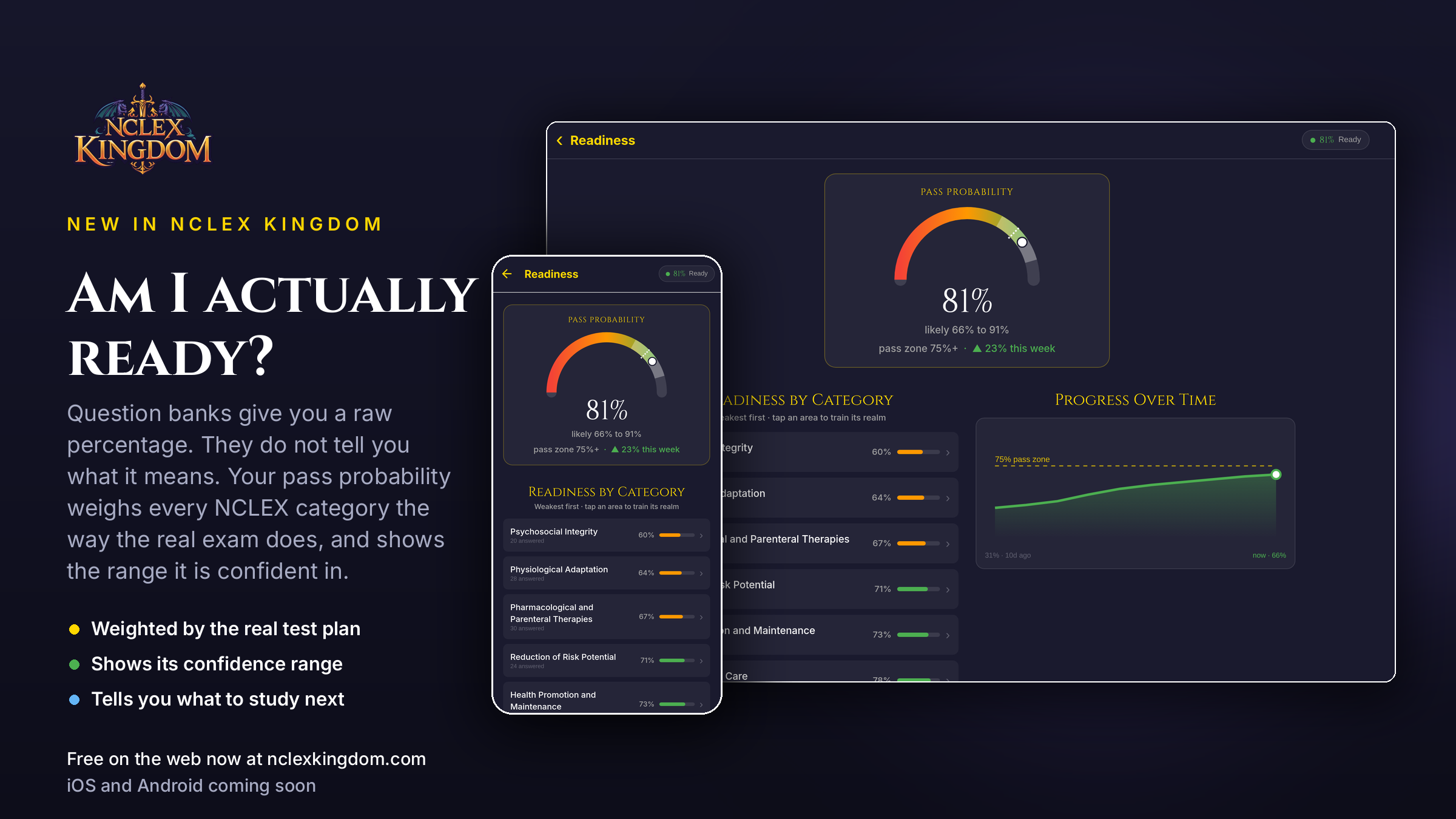
Your pass probability is a single number, at the top of the app, that answers the question directly. Here is what sits behind it.
It weighs each area the way the real exam does
The NCLEX-RN test plan does not treat all content equally. In the NCLEX-RN Test Plan effective April 2026, Management of Care is 18% of the exam and Pharmacological and Parenteral Therapies is 16%, while Basic Care and Comfort and Psychosocial Integrity are 9% each. Being strong in the small categories and weak in the big ones is a very different situation from the reverse, and an overall average hides that completely.
We weight every NCLEX Client Needs category by its real share of the exam. A gap in a heavily weighted area pulls your number down harder, because on test day it will.
Material you have never touched counts against you
This is where most score estimates quietly flatter you. If you have never practised Psychosocial Integrity, a plain average simply ignores it, and your number looks better for having avoided your weak spots.
We do the opposite. An area counts as fully measured once you have answered enough questions in it. Below that, we blend what we have actually measured with a neutral assumption about what we have not. Skipping a category does not protect your score. It holds it down until you go and do the work.
It shows the range it is confident in, not just a number
This is the part we are most pleased with, and the part most tools leave out.
Any estimate built from a sample has uncertainty, and early on that uncertainty is enormous. So the app shows a range alongside your number: your estimate, and the band it is genuinely confident about. Practise more, across more areas, and you can watch that band tighten.
We built the range out of two separate pieces, because they are different kinds of unknown:
- Sampling uncertainty on the material you have practised. Twenty questions tell us less than two hundred, and the range reflects that.
- Assumption uncertainty on the material you have not. When most of an estimate rests on a stand-in value rather than your actual answers, the honest thing to do is say so with a wide band.
A tight range around a number that is mostly guesswork would look more authoritative and mean less. We would rather show you something true.
It refuses to guess when it does not know
Open a fresh account and you will not see a low score. You will see no score at all, plus a note telling you roughly how many questions it needs before an estimate means anything.
That was a deliberate decision. When we first built the engine, a brand new user with zero answers was shown a specific, discouraging number, because that is what the maths produced with no data. It was technically the model's output and it was useless information. Worse, it was demoralising on day one, before anyone had answered a single question.
"We do not know yet" and "you are likely to fail" are completely different messages. They should never look the same.
It tells you what to do next
A number on its own creates anxiety. A number with a next step creates a study plan.
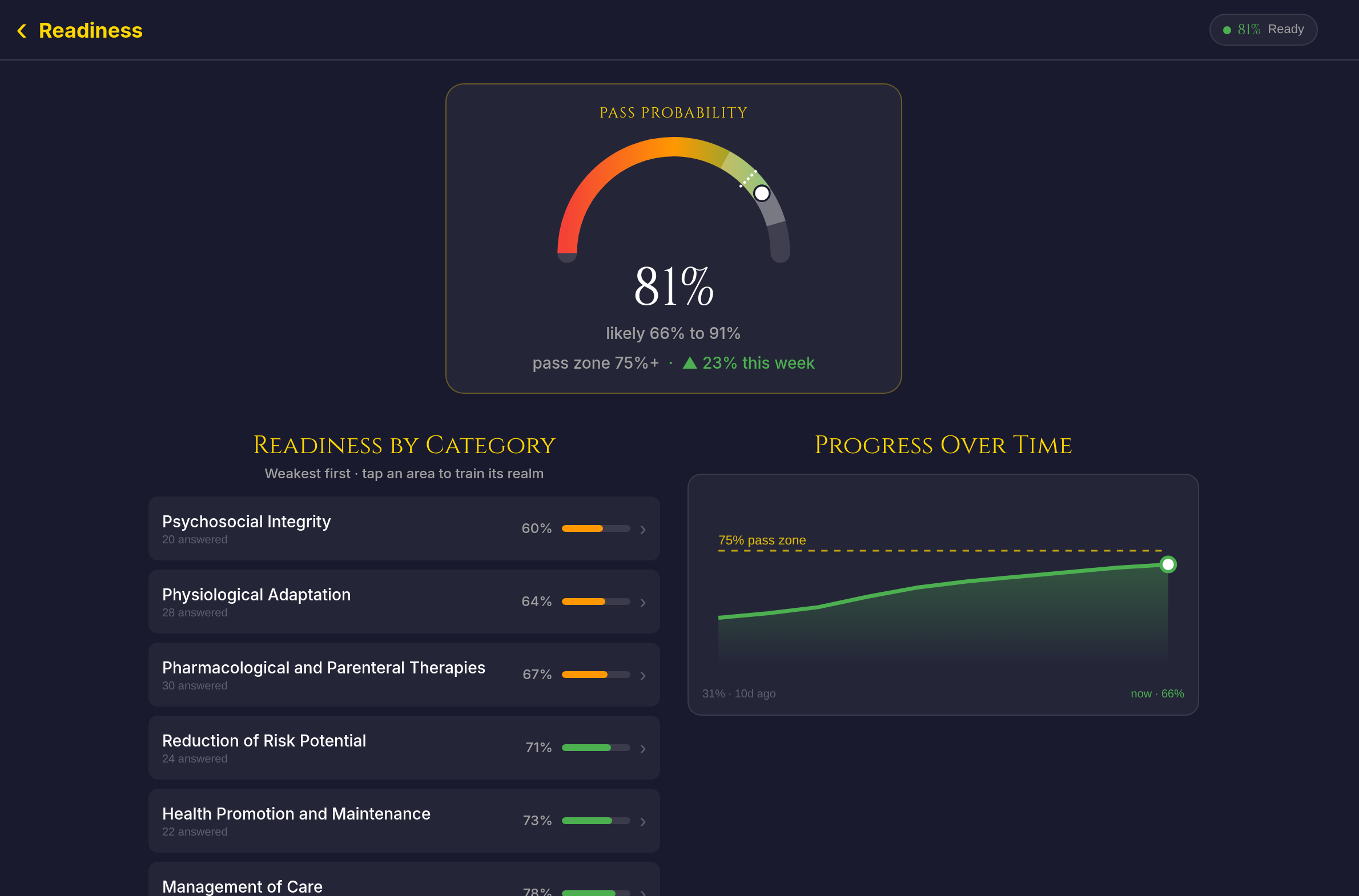
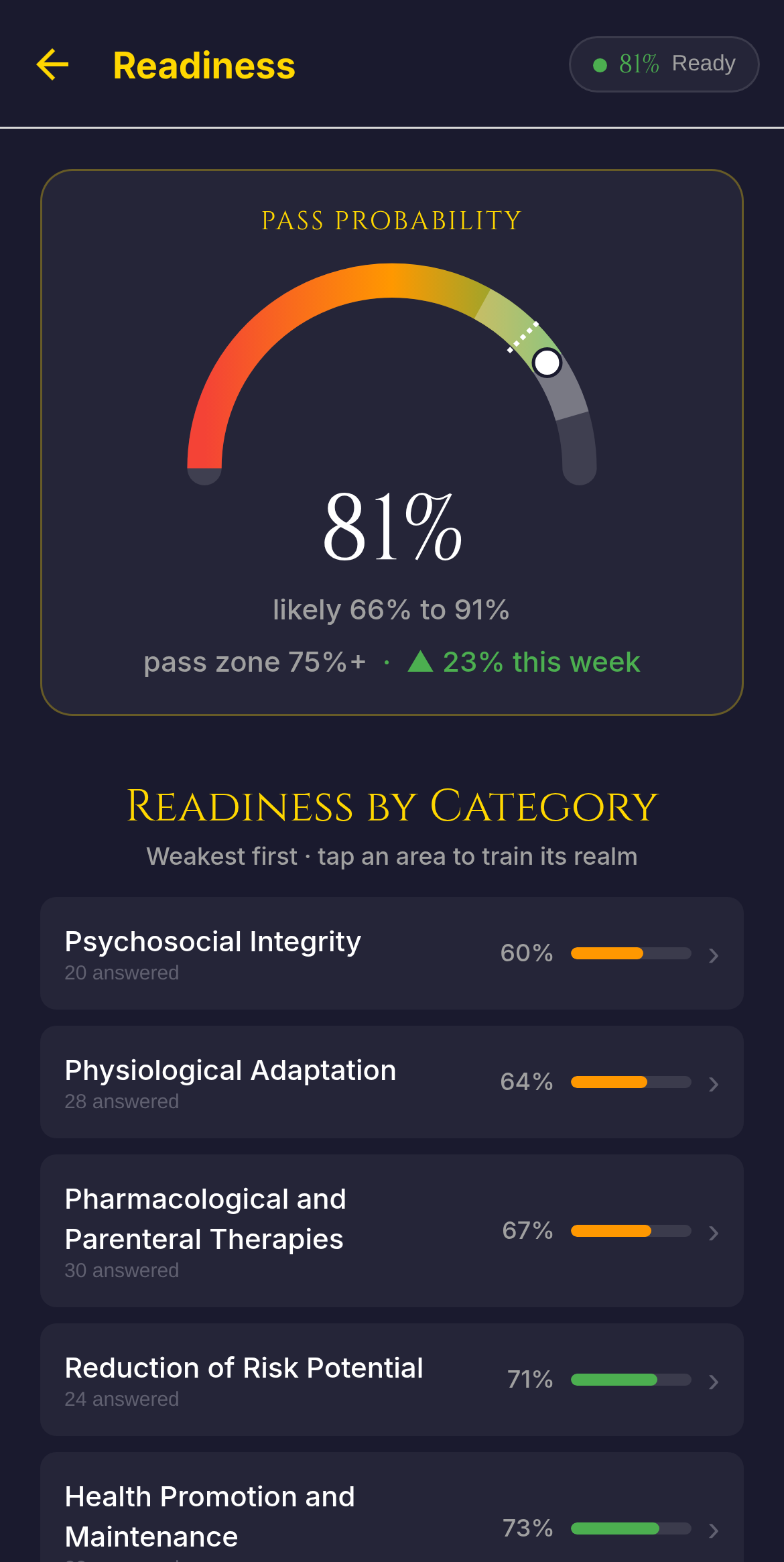
Under the gauge, every NCLEX category is listed weakest first, with your accuracy and how much you have practised. Tap any one of them and you go straight to the realm that trains it. The worst thing you can be told is that you are at 58% with no idea which 42% to fix.
It shows the climb
Progress in NCLEX prep is invisible on any given day, which is exactly why motivation dies. So we keep a nightly snapshot and plot the line, with the pass zone marked, so months of work become something you can actually see.
We Will Tell You What It Is Not
We think you should be sceptical of any app that puts a number on your chances and does not explain itself, so the app has a permanent "How This Is Calculated" section that lays out the weightings, the coverage rule, and the maths in plain language. Nothing is hidden behind a marketing claim.
In that same spirit: this is an estimate built from your practice inside our app. It is not a guarantee, it is not affiliated with or endorsed by NCSBN, and it has not yet been calibrated against real pass and fail outcomes. It is a study guide, not a verdict. As real outcome data comes in, the model gets better, and we will say so when it does.
Try It
Your pass probability is live on the web right now and free to use. Practise a few questions across a handful of categories and it will unlock.
It is coming to the iOS and Android apps soon.
Start practising free in your browser →
We built this because "am I ready?" is the question every NCLEX student is actually asking, and nobody was answering it honestly. If you try it and it tells you something useful, or something wrong, we want to hear about it.